Living Room Ceiling Lights: How to Choose Fixtures That Actually Flatter Your Space (2026)
You know that feeling when your living room looks great in daylight… and then you flip on the overhead light and everything turns flat, harsh, or yellow? That is not your furniture’s fault. It is your ceiling lighting.
In 2026, good living room ceiling lights are less about one giant fixture in the middle of the room and more about a thoughtful mix of height, brightness, and mood. The right choices can make a low ceiling feel higher, a small room feel calmer, and your sofa fabric look like it does in the showroom.
Let’s walk through it step by step, starting with a quick cheat sheet so you do not buy the wrong type of fixture for your ceiling height.
Quick Guide: Which Ceiling Light Fits Your Room?
Think of this as your decision matrix before you even open a shopping tab.
Quick Guide: Which Ceiling Light Fits Your Room?
| Ceiling Height | Best Fixture Type | Clearance Rule |
|---|---|---|
| Under 8 ft | Flush mount, low-profile semi-flush, track or recessed | Keep at least 7 ft from floor to bottom of fixture. |
| 8–9 ft | Semi-flush, small chandelier, shallow pendant | Bottom of fixture 7–7.5 ft above floor. |
| 9–10 ft | Medium chandeliers, pendants, linear suspensions | Aim for 7.5–8 ft clearance in main traffic areas. |
| Over 10 ft / vaulted | Statement chandeliers, multi-pendant clusters, linear suspensions | Bring the light down: hang so light source feels visually connected to seating zone, not floating at the peak. |
In practice, this means:
- Low ceilings: focus on the best lighting for low ceilings, not the biggest fixture. A slim drum flush mount with great bulbs will always beat a tiny chandelier hung too high.
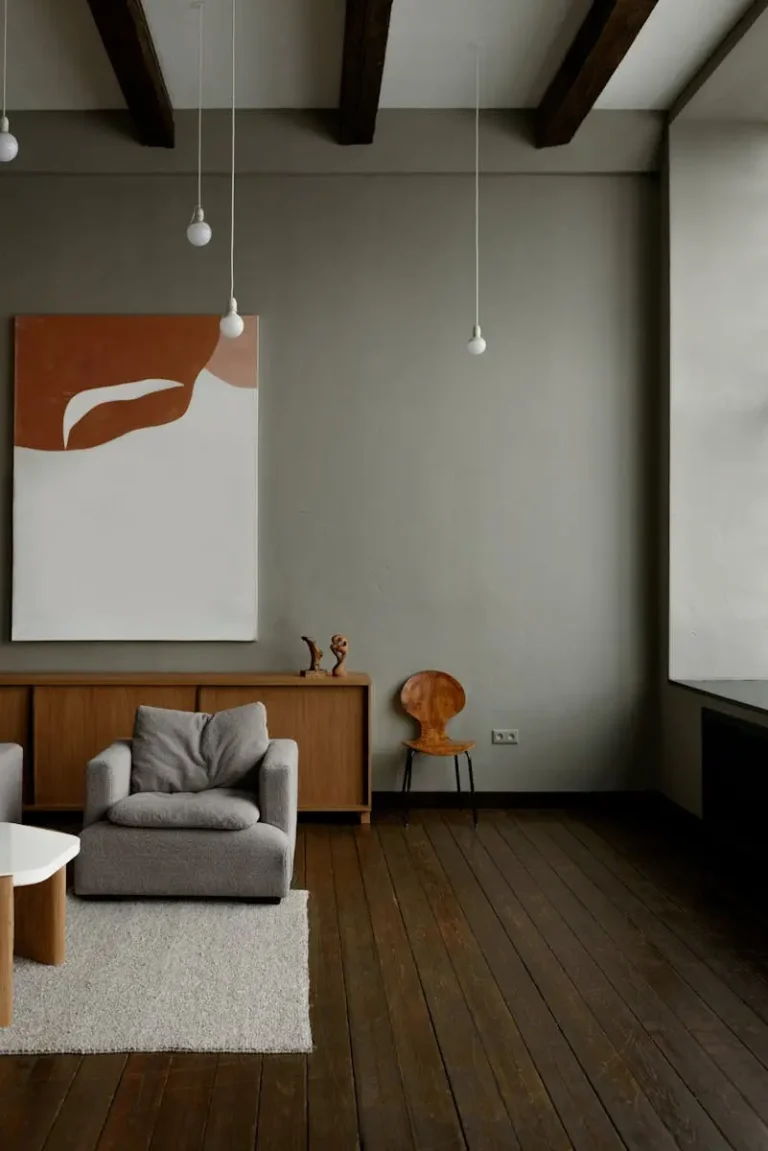
- Tall or vaulted ceilings: you almost always need a fixture that hangs down into the room so the light feels human scale.
Now that you know what type of fixture your ceiling can actually handle, let’s talk about the science behind light so your living room feels warm and flattering, not like an office.
The Science of Living Room Lighting (What Experts Know)
Understanding Color Temperature (Kelvin)
Color temperature is the one number that quietly decides if your living room feels cozy, clinical, or dingy.
- 2200–2400K: extra warm, candle-like (great for accent lamps, but too orange as the only light).
- 2700–3000K: sweet spot for living rooms. Warm white that flatters skin and fabrics.
- 3500–4000K: neutral white. I only use this in kitchens or workspaces.
- 5000K+: daylight. Fantastic for garages and studios, harsh for relaxing spaces.
In my experience, if your living room feels “cold” at night, you are probably sitting under 4000K or 5000K bulbs. Swap to 2700K and it is like the room exhales.
Practical tip:
For living room ceiling lights, I recommend 2700K bulbs in the main fixture, and 2700–3000K max in any recessed or track lighting. Keep them all consistent so you do not get a patchwork of yellow and blue.
The 3 Layers of Light
If you only remember one design rule from this guide, let it be layered lighting.
- Ambient light
- The overall wash of light in the room.
- Usually your ceiling lights: flush mount, chandelier, recessed, or track.
- Purpose: make the room safe and functional.
- Task light
- Focused light for a specific job: reading, knitting, board games.
- Floor lamps by the sofa, swing-arm wall lamps, a bright lamp on a side table.
- Accent light
- Light that highlights something: art, a stone fireplace, a plant corner.
- Picture lights, small spotlights, LED strips on top of shelves.
A well-lit living room usually has at least one source in each layer. Ceiling lights set the base, but they should not be doing all the work alone.
Lighting for Wellness (Circadian Rhythms)
This is where lighting moves from “pretty” to “healthy.”
Your body’s internal clock (circadian rhythm) responds to light color and intensity:
- Morning / day: brighter, cooler light tells your brain it is time to be alert.
- Evening: dimmer, warmer light tells your brain it is time to wind down.
In a living room, I like this rhythm:
- Daytime: blinds open + ceiling lights on a lower level if needed.
- Late afternoon: ceiling lights dimmed, table and floor lamps doing more of the work.
- Night: mostly lamps and accent lighting, ceiling lights very dim or off.
If you want to play with circadian rhythm lighting, use smart bulbs in your living room ceiling lights and lamps. Program them to shift from 3000K in the afternoon down to 2200–2700K in the evening. It is subtle but you feel it.
Living Room Ceiling Lights: 2026 Trends and Layout-Based Solutions
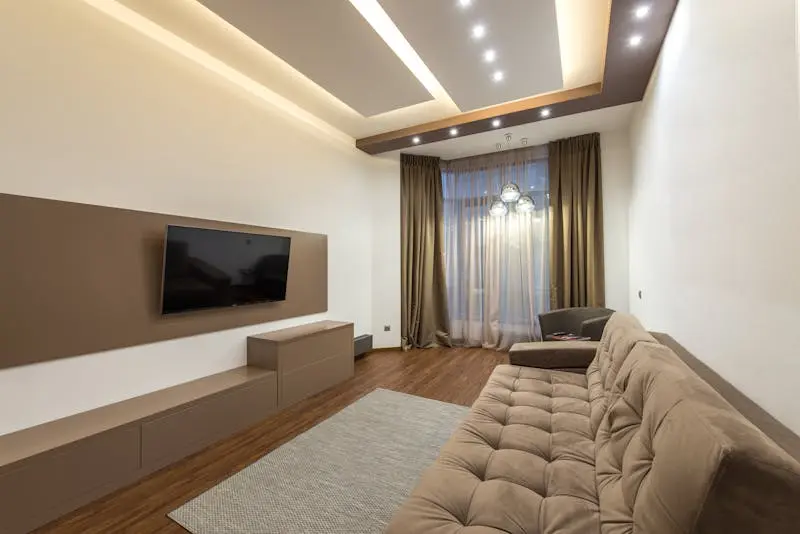
Now that the science is out of the way, let’s talk about what is actually trending and what is worth investing in.
Category A: The 2026 Trends
1. Biophilic Lighting
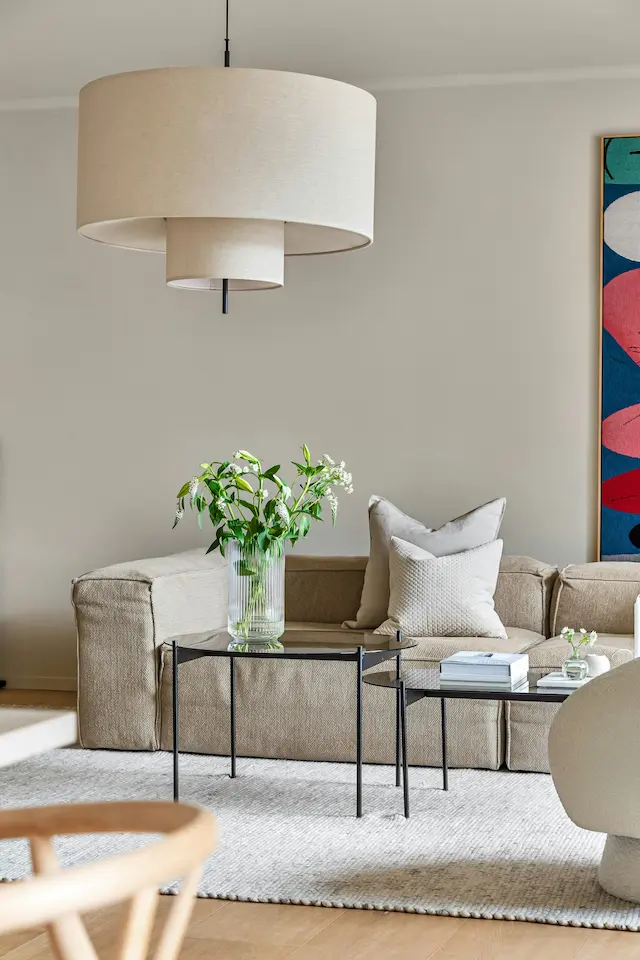
Fixtures made from rattan, wood, paper, or woven fibers are everywhere right now.
I like them because:
- They soften the geometry of a flat ceiling.
- They filter light in a very flattering, dappled way.
- They tie in beautifully with plants and organic modern decor.
Just keep the shapes simple: clean drums, gentle curves, nothing overly boho unless that is your whole scheme.
2. Oversized Statement Floor Lamps (As Ceiling Support)
Technically not ceiling lights, but they do a lot of the heavy lifting in living rooms where the ceiling fixture is weak or non-existent.
- Arc floor lamps can visually act like a pendant over a coffee table.
- Large sculptural lamps add height and drama without changing the ceiling wiring.
In small spaces, I prefer one large, bold lamp over three tiny ones. Less visual clutter, more intention.
3. Vintage & “Aged” Metals
Modern ceiling design in 2026 is moving away from everywhere-chrome.
- Unlacquered or brushed brass, pewter, and blackened metals feel warmer.
- On low ceilings, a soft brass semi-flush drum reads more elegant than shiny chrome.
You do not need your ceiling lights to match every metal in the room, but try to keep them in the same temperature family (all warm metals or all cool).
4. Rechargeable “Nomad” Lamps
Not on the ceiling, but very relevant for layered lighting:
- These little cordless lamps can sit on shelves, window sills, or even balance beams in older homes.
- They are perfect if your ceiling lights are bright but the corners feel dead.
I often use them to simulate accent spots where wiring would be a pain.
Category B: Solutions for Specific Layouts
5. Lighting for Low Ceilings
Best lighting for low ceilings is all about profile and spread:
- Choose slim flush mounts or very low semi-flush fixtures that hug the ceiling.
- Look for wide diffusers so the light spreads evenly instead of creating a harsh spotlight.
- Avoid chunky fans or chandeliers that sit too low; they visually “press down” on the room.
If your ceiling height is under 8 ft, I recommend:
- One good flush mount on a dimmer for ambient light.
- Plus wall sconces or floor lamps for warmth and character.
6. The “Dark Corner” Solution
Every living room has that one corner that feels like a void after sunset.
Instead of relying only on ceiling lights:
- Add a tall, slender floor lamp that throws light upwards and downwards.
- Or use a plug-in wall sconce placed higher on the wall to pull the eye up.
You are not just lighting the corner; you are visually balancing the brightness across the room so one area does not feel like a cave.
7. Small Living Room Hacks
When floor space is tight:
- Use wall sconces instead of floor lamps to free up footprint.
- If you cannot hardwire, plug-in sconces with cord covers are your friend.
- Pair a compact flush mount with two sconces on either side of the sofa for a tailored, hotel-style look.
This combination often looks more intentional than one lonely ceiling fixture struggling to light everything.
Category C: Tech & Smart Integration
8. Invisible Tech (Smart Bulbs in Pretty Fixtures)
You do not need futuristic fixtures to get smart control.
In my experience, the best approach is:
- Choose ceiling lights you genuinely love aesthetically.
- Add smart bulbs inside them for dimming, schedules, and color temperature shifts.
This keeps your living room looking modern but not “tech showroom,” and lets you play with circadian-friendly lighting without committing to complex systems.
9. Scene Setting
One of the most underrated living room lighting ideas is using “scenes”:
- Movie Mode: ceiling lights off or at 10%, warm table and floor lamps only.
- Reading Mode: ceiling at 30–40%, reading lamp bright.
- Entertaining Mode: ceiling at 60–70%, all accent lights on for sparkle.
Set these once in your smart app and you will actually use your living room lighting in a way that supports how you live, not just “on/off.”
How to Layer Living Room Lighting Like a Pro
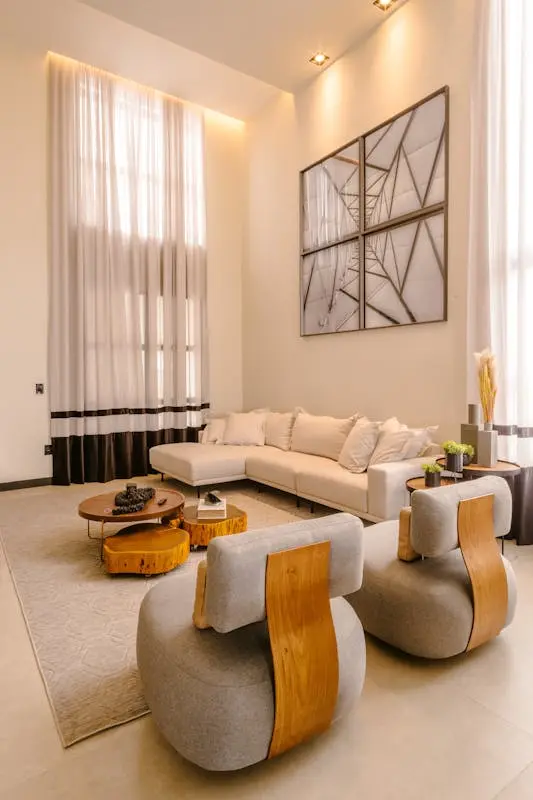
How to Layer Lighting Like a Pro
Think of it as an equation:
1 overhead + 2 eye-level sources + 1 accent = a balanced living room.
You can scale that up for larger rooms, but the ratio is solid.
Step-by-step:
- Start with the ceiling light
- Choose a fixture appropriate for your ceiling height (from the table above).
- Put it on a dimmer. This is non-negotiable in my book.
- Add two eye-level lights
- Example: a floor lamp by the sofa and a table lamp on a sideboard.
- Aim to place at least one on each side of the room so the light feels balanced.
- Add one accent source
- A picture light over art, LED strip on top of cabinets, or a small spotlight on a plant.
- This creates depth and makes the room feel designed, not just lit.
If it still feels off, the problem is almost never “not enough lumens” and almost always “too much light from one place.” Spread it around the room.
Technical Specs You Should Not Ignore
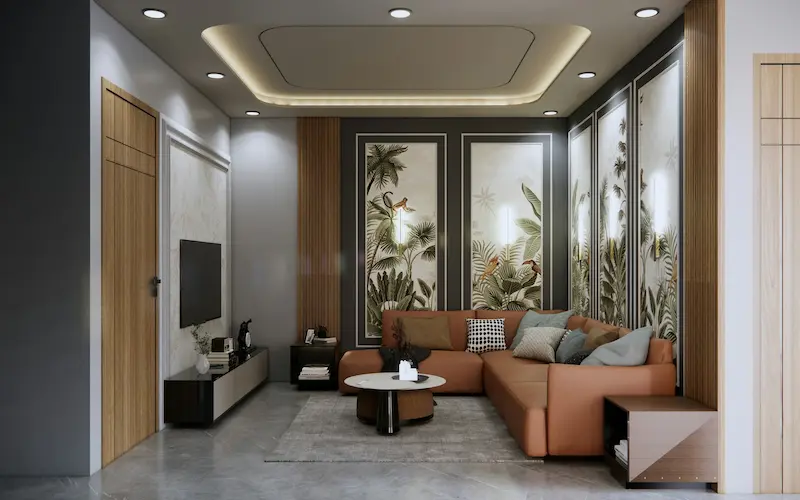
Here is where your living room ceiling lights either make everything look high-end or mysteriously cheap.
The Technical Specs You Can’t Ignore
The CRI Factor
CRI (Color Rendering Index) measures how accurately a light source shows color compared to natural light.
- 80 CRI: standard. Colors can look a bit dull or off.
- 90+ CRI: what I recommend for living rooms. Fabrics, wood tones, and skin look richer and more accurate.
If you spent money choosing the perfect neutral sofa or rug, low CRI bulbs will flatten it completely. Do not waste your decor budget with bad light.
Beam Angles
If you are using recessed or adjustable ceiling fixtures, beam angle matters.
- Narrow beam (15–30°): spotlight. Good for accenting art, not for general room light.
- Medium (30–60°): better for targeted task zones.
- Wide (60°+): ideal for ambient light in living rooms.
In a typical living room, I prefer wider beams so you do not end up with bright circles on the floor and dark gaps in between.
Smart Protocols
If you are investing in smart living room ceiling lights in 2026, I would:
- Choose bulbs or fixtures that work with modern standards like Matter / Thread (this just keeps everything talking to each other in the future).
- Avoid locking yourself into a single brand’s walled garden.
The goal is flexibility: you can upgrade your phone, your router, your voice assistant, and your lights still play nicely together.
Solving Common Ceiling Problems
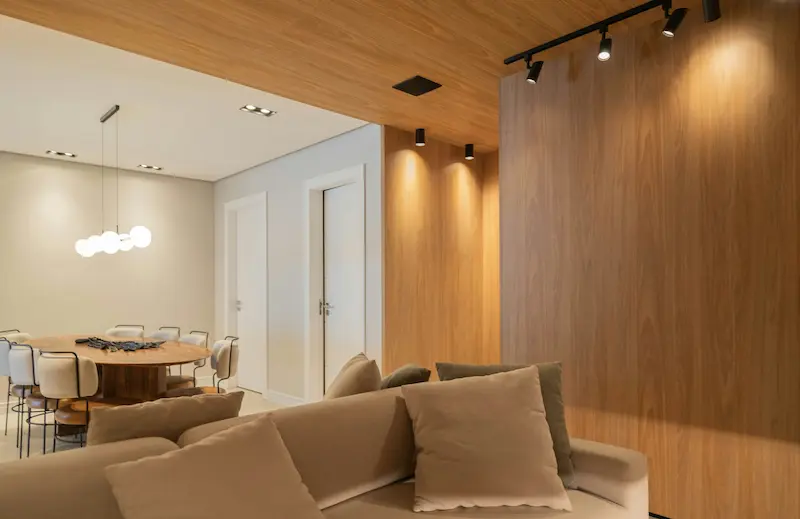
Solving Common Ceiling Problems
Let’s tackle the tricky situations I see all the time.
Scenario A: “I have concrete ceilings and can’t drill.”
You still have options:
- Use swag pendants: plug-in pendants that hook into the wall or ceiling with adhesive or removable hooks, then drape the cord.
- Lean into the look: exposed conduit or cord can feel intentional and industrial if it is done neatly and paired with a simple, modern shade.
In this case, I like to treat the ceiling as a fixed plane and focus on great floor lamps and wall lights as the main lighting layer.
Scenario B: “My room is huge.”
One lonely living room ceiling light in the middle of a large room is guaranteed to look sad.
Instead:
- Create zones: a main fixture over the seating area, maybe a second over a reading nook or game table.
- Think of multiple center points rather than one. Each activity area gets its own “ceiling moment.”
You can still keep everything cohesive by choosing fixtures in the same finish or style family.
Scenario C: “I rent.”
Hardwiring might be off the table, but you are not stuck with bad lighting.
- Replace ugly flush mounts with nicer ones and keep the old fixtures in a box to re-install when you move out.
- Use plug-in pendants and swag them where you need overhead emphasis (over a coffee table, for example).
- Add smart bulbs to control color temperature and dimming without touching the wiring.
In my experience, renters get the biggest transformation from three things: a nicer flush mount, one great floor lamp, and warm-white bulbs everywhere.
If you take nothing else from this guide, let it be this: your living room ceiling lights are not just hardware. They are the lens through which you see every other design choice you have made.
Get the height right, pick the right type for your ceiling, choose warm (2700–3000K) high-CRI bulbs, and layer in lamps and accents. Your existing furniture will suddenly look more expensive, and your living room will finally feel as good at night as it does on your inspiration board.