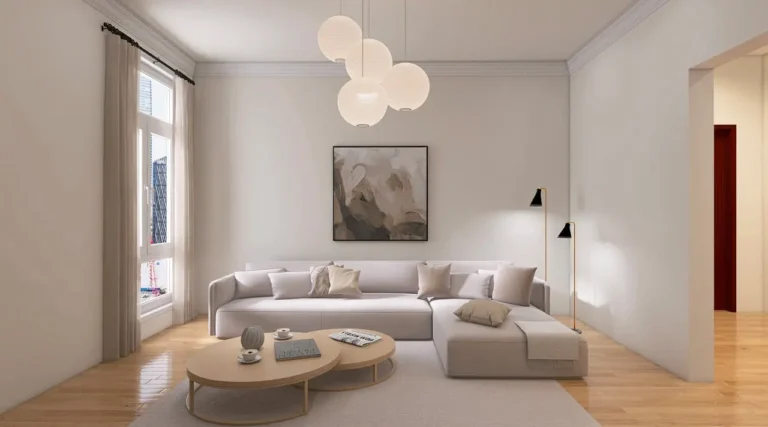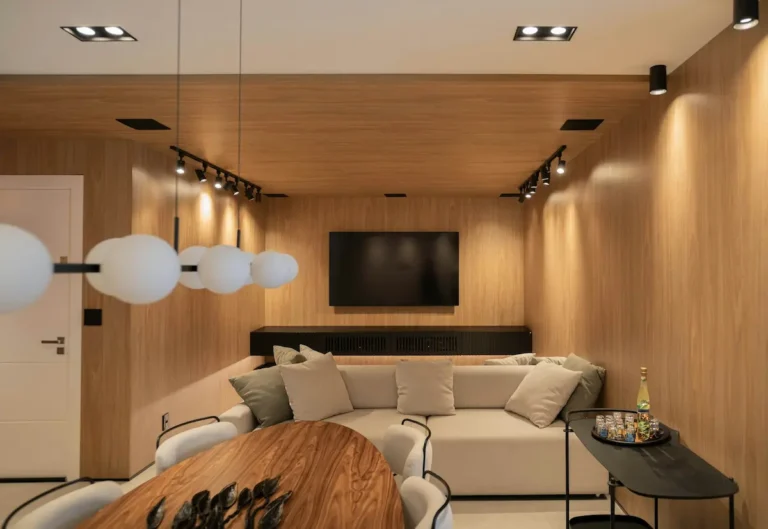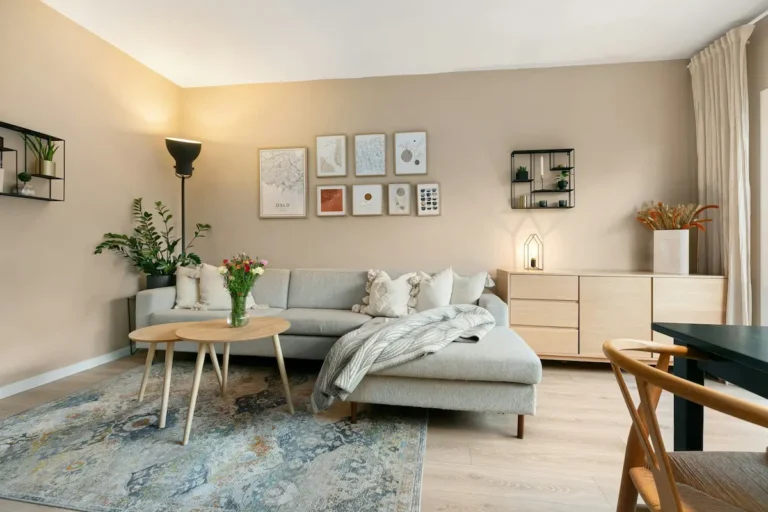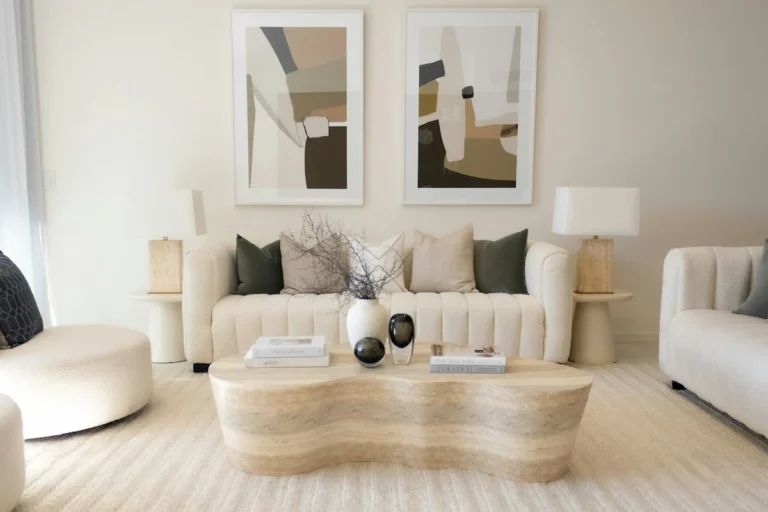
Living room wall décor ideas for your home
The secret to getting living room wall decor right is not how many pieces you hang, but where and how you place them. Most successful living room wall decor ideas start from one simple guideline: hang the center of your art at roughly 57–60 inches from the floor, which is standard eye level in galleries. From there, you build the wall using three powerful tools: one oversized statement piece, a repeated arrangement like a grid gallery, or functional elements such as shelving and sconces that also act as decor.
Those three options form the backbone of almost every well–designed wall.
I. The 57–Inch Rule & The Big Three
Let’s start with the two rules that will instantly make your living room wall decor look professionally planned.
1. The 57–60 Inch Rule
In galleries, the center of a piece of art usually sits around 57 inches from the floor. In a home, you can stretch this to 60 inches if your ceilings are tall or you’re taller than average, but staying in that band keeps things feeling grounded and intentional.
In practice:
- Measure 57–60 inches from the floor.
- Mark that point lightly with pencil.
- That mark should line up with the center of your artwork, not the top.
If your living room wall decor ideas have ever looked “off” without knowing why, it was probably a scale or height issue, not the art itself.
2. The Rule of Three: How to Fill a Wall
Most modern living room ideas for walls fall into three categories:
- Statement Art (Oversized)
One big piece that does most of the talking. Think a large canvas, an XL print, or a sculptural mirror. This is ideal if you like a clean, minimal look. - Repetitive Patterns (Grid or Linear Gallery)
A series of similar pieces in a grid or straight line. This suits modern or transitional spaces and is perfect for “modern wall art for living room” searches. - Functional Decor (Shelves, Sconces, Peg Rails)
These are pieces that earn their keep: picture ledges, wall shelves, or sconces that frame your sofa. Especially good in small living room decor where every inch has to work hard.
Think of these three as your toolbox. Every wall in your home can be solved with some combination of them.
II. Solving the Scale Problem: Size, Height, and Proportion
If you remember only one thing from this guide, let it be this: too small is worse than too big on a large wall.
How to Choose the Right Size Decor for Your Wall
In my experience, the biggest mistake people make with living room wall decor ideas is picking art that’s far too small, especially above a sofa.
Use this simple formula:
- Aim for your wall decor to take up 60–75% of the available wall width above furniture.
If your sofa is 210 cm wide, your artwork or arrangement should be roughly:
- 0.6 × 210 = 126 cm
- 0.75 × 210 = 157.5 cm
So you’re aiming somewhere between 125–155 cm wide for the overall arrangement.
Above the Sofa: The 2/3 Rule
For art above a sofa:
- Make your art (or gallery arrangement) around two–thirds the width of the sofa.
- Hang it 15–25 cm (6–10 inches) above the sofa back so it feels connected, not floating.
If you already own a piece that’s too small, don’t panic. You can:
- Add two slim wall sconces either side.
- Layer smaller art with picture ledges to increase the overall footprint.
- Pair it with a second piece to create a diptych.
Vertical vs Horizontal: Match the Wall Shape
- Tall, narrow walls (between windows, next to doors):
Choose vertical art, stacked frames, or a slim grid. - Wide, short walls (behind the sofa, above a low console):
Choose horizontal pieces or a wide gallery layout.
In short: let the size and shape of the wall choose the art, not the other way around.
III. The Gallery Wall Playbook: 5 Layouts That Always Work
A lot of people love gallery walls in theory but get overwhelmed in practice. I like to work with templates. Here are five layouts that rarely fail.
1. The Symmetrical Grid
Perfect if your style leans modern, minimal, or “quiet luxury.”
- Use identical frames and mats.
- Arrange in a 2×3, 3×3, or 3×4 grid.
- Keep spacing consistent (around 5–8 cm / 2–3 inches between frames).
This works beautifully for:
- Black–and–white photography
- Botanical prints
- Line drawings
If you’re decorating a large wall, a grid is one of the cleanest and most sophisticated living room wall decor ideas you can use.
2. The “Heart” Layout
Here, you start with one central piece and build out around it.
- Place the largest, most meaningful piece at the center (eye level).
- Add smaller pieces around it, keeping gaps consistent.
- Aim for an organic, rounded silhouette rather than a perfect square.
This suits:
- Boho, eclectic, or collected interiors
- Family photo walls
- Art you’ve gathered over time
It looks best when the frames share at least one common element: all black frames, all light wood, or all white mats.
3. The Picture Ledge Wall
If you like to swap art constantly, picture ledges are your best friend.
- Install one or two long ledges above the sofa or behind a sideboard.
- Layer frames of varying sizes, overlapping slightly.
- Mix in a small plant or a sculptural object for depth.
This is an excellent renter–friendly alternative to a fully nailed–in gallery wall and keeps things flexible.
4. The Diptych or Triptych
Instead of a busy gallery wall, use two or three coordinated pieces in a row:
- Maintain equal spacing (again, 5–8 cm / 2–3 inches is a safe range).
- Keep the bottom edges aligned for a calm, modern look.
This works particularly well for:
- Landscapes split into multiple panels
- Abstract art series
- Neutral prints for modern neutral living rooms
5. The Mixed Media Wall
If you want something more dramatic for a modern living room:
- Combine framed art with a wall–mounted shelf, a sconce, and maybe a sculptural mirror.
- Keep a clear visual “line” so it still feels deliberate: imagine an invisible horizontal or vertical axis that pieces line up with.
The key with any gallery wall: plan it on the floor first, then transfer to the wall.
IV. Beyond Frames: Textural and 3D Wall Decor Ideas
If your living room wall decor ideas feel flat, it’s usually because everything is two–dimensional: paper in frames. Let’s add depth.
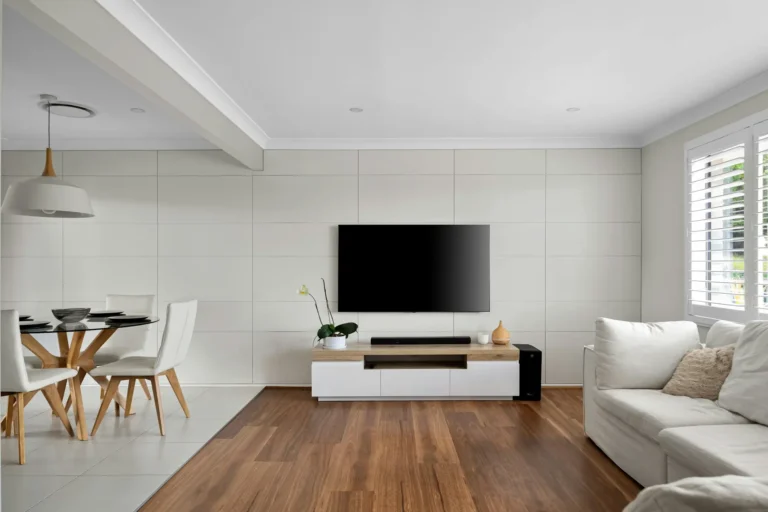
Modern Molding & Trim
One of my favorite tricks for large wall decor ideas that still feel subtle is wall molding:
- Install picture–frame molding or wainscoting painted the same color as the wall.
- You can leave it empty for a very modern, architectural look.
- Or place a single large artwork inside one of the panels.
This works beautifully in both modern neutral living rooms and more classic spaces.
Biophilic Decor: Living Walls and Hanging Planters
If you want something softer than hard frames:
- Use wall–mounted planters with trailing plants.
- Consider a small “living wall” with a grid of identical pots.
- Keep the plant palette simple to avoid visual chaos.
Plants add color, movement, and softness to even the most modern wall art for living room setups.
Functional Decor: Mirrors, Shelves, and Sconces
Some of the best living room wall decor ideas are the ones that solve problems:
- Oversized mirrors to bounce light and visually widen a small living room.
- Floating shelves styled with books, candles, and small sculptures.
- Wall sconces either side of art or above shelving to add depth and evening atmosphere.
In my experience, a mix of flat art + 3D elements makes a wall feel “designed,” not just “filled.”
V. Living Room Wall Decor for Renters and Real Budgets
You do not need a contractor – or permission to drill ten holes – to have a good wall.
The No–Drill Toolkit
For renters or those nervous about damage, I recommend:
- Command hooks and strips for lighter frames and small mirrors.
- Leaning art: oversized canvases or mirrors resting on the floor behind a plant or side table.
- Tension–rod tapestries between two walls or inside alcoves.
You can create a full gallery with adhesive strips if you respect the weight limits and allow them to cure properly.
The $50 Wall Makeover
If your budget is tight, focus on creativity:
- Frame wallpaper samples, pages from large–format books, or vintage scarves.
- Paint mismatched thrifted frames all one color (black or soft beige) so they feel like a set.
- Add a DIY picture ledge from a simple pine board and paint it to match the wall.
This is where “small living room decor” can beat designer rooms: the styling feels personal, not generic.
VI. Frequently Asked Questions About Living Room Wall Decor
Let’s tackle the questions that come up constantly when people start searching for living room wall decor ideas.
1. How do I decorate a large, high–ceiling living room wall?
For double–height walls, small art is your enemy.
I recommend:
- One very large statement piece or a vertical stack of pieces.
- Tall elements like vertical panels of molding, oversized mirrors, or tall bookcases.
- Avoid scattering small art high up; it looks like visual “dandruff.”
If your budget doesn’t stretch to huge canvases, go for:
- A grid gallery of 6–12 identical frames.
- Painted wall panels or color–blocking to divide the wall into zones.
2. Should wall decor be centered on the wall or the furniture?
Always center your living room wall decor relative to the furniture, not the wall.
- Above a sofa, center the art on the sofa.
- Above a console, center on the console.
- In a dining nook, center on the table.
The only time I center art on the wall itself is when there is no furniture below it and that wall is a true standalone feature.
3. What is the wall decor trend for 2026?
Instead of quote signs and tiny scattered frames, the trend is shifting toward:
- Fewer, larger pieces rather than many small ones.
- Textural elements like canvas, plaster, and fabric art.
- Modern wall art for living rooms that is abstract and calming rather than busy.
In other words: less visual noise, more intentionality.
4. How can I make a small room look bigger with wall decor?
For small spaces, your living room wall decor ideas should work like optical tricks:
- Use large art instead of lots of small pieces – it actually feels calmer.
- Hang one tall mirror to stretch the room vertically.
- Keep frames and mats in a limited color palette (black, white, or natural wood).
I also prefer keeping at least one main wall relatively simple in a small living room so the room feels breathable rather than cramped.
Final Thoughts
If your walls feel unfinished, you do not need more stuff. You need better rules.
- Hang at eye level.
- Fill about two–thirds of the space above your key furniture.
- Decide whether this wall will be about one big statement, a repeated pattern, or functional decor – and then commit.
From there, you can layer in style: modern, boho, neutral, maximalist. The principles don’t change. And once you understand them, every new piece you bring home will feel like it belongs, rather than “one more thing on the wall.”